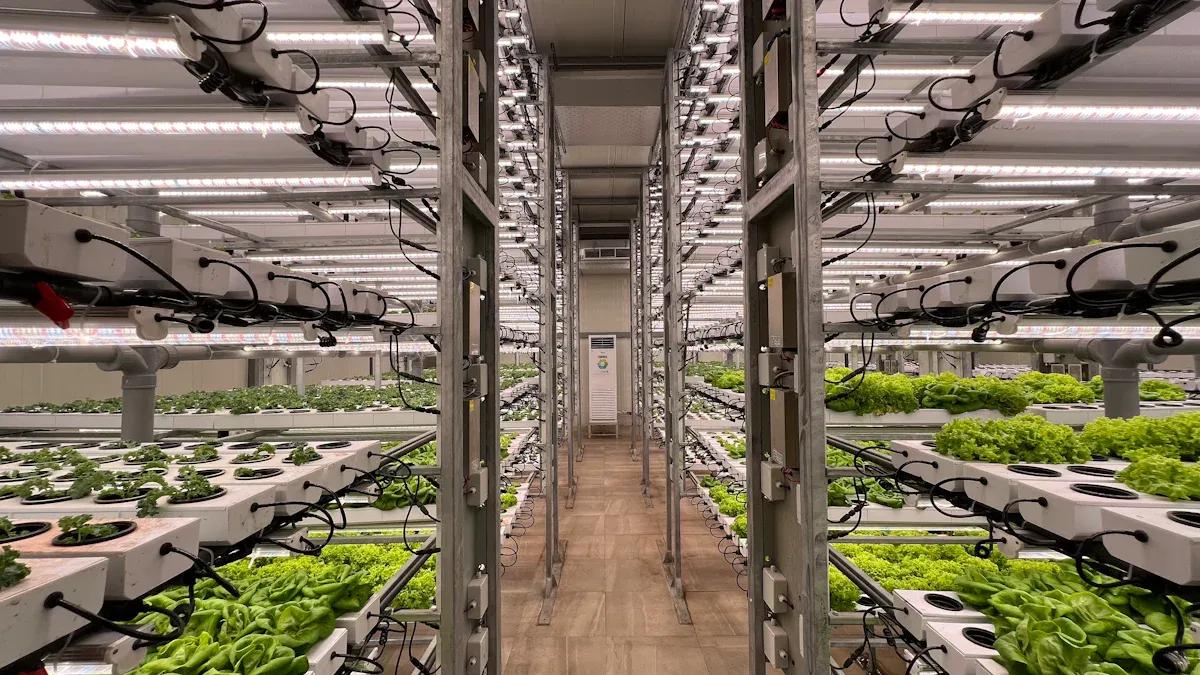
Vertical farming lighting gives fake light to help plants grow inside. This light is used in stacked layers. It takes the place of sunlight. It gives crops what they need to grow inside buildings. Many farms use vertical farming lighting instead of sunlight. This lets people grow food in cities or places with little land. The global market for vertical farming was $5.1 billion in 2023. It may reach $15.3 billion by 2028. This shows more people are using this way to farm:
Year | Market Size (USD Billion) | CAGR (%) |
|---|---|---|
2023 | 5.1 | 24.7 |
2028 | 15.3 |
You can grow lettuce all year, even in winter. You do this by controlling every light your plants get. How could changing the light change what you eat?
Key Takeaways
Vertical farming lighting uses fake lights, like LEDs, to help plants grow inside. This lets farmers grow crops all year.
Changing light color, strength, and time helps plants grow better. It lets people grow food in cities with little sunlight.
LED lights save energy and can cut lighting costs by 40-60% compared to old lights. This helps farms spend less money.
Smart lighting systems change lights by themselves based on what plants need. This makes crops better and cuts down on waste.
Picking the right light mix, mostly blue and red, helps photosynthesis. This makes crops healthier and gives them more nutrients.
What Is Vertical Farming Lighting?
Definition and Core Principles
Vertical farming lighting helps plants grow at hydroponic systems. It uses fake light for crops stacked in layers. Experts say vertical farming lighting means using fake lights, like LEDs, to help plants grow in layers inside. You can change the color, strength, and time of the light. This helps plants grow better and gives more food.
You can set the light for each plant. You pick the color and how bright the light is. You also choose how long the plants get light. These choices help plants grow well, even without sunlight. Technology helps plants get the best light for photosynthesis and growth.
Tip: You can change the light for each crop. This lets you grow lettuce, strawberries, or herbs with year-round production, even if the weather is bad.
Vertical vs. Traditional Lighting
Vertical farming lighting is different from old ways of lighting. Here are the main ideas:
Vertical farming uses fake lights made for plants. It focuses on the color and strength of the light.
Traditional farming uses sunlight, which you cannot control.
Controlled Environment Agriculture (CEA) in vertical farming lets you control light and other things plants need.
In vertical farms, you use fake lights because there is no sunlight inside. The kind of light you pick changes how plants look and grow. You can use LEDs to give plants steady and changeable light. This helps you control plant growth better than sunlight.
Studies show the best light for plants is in the visible (400–700 nm) and infrared (700–800 nm) range. LEDs in vertical farming lighting give plants these exact colors. In traditional farming, you use all sunlight, which you cannot change.
You get more control with vertical farming. You can grow food where there is little sunlight or space. You can also make year-round food production. This makes vertical farming lighting very important for modern farming.
Importance of Lighting in Vertical Farming
Plant Growth and Yield
Plants in vertical farms need strong lighting to grow well. Artificial lights give plants energy for photosynthesis. If you control the light, plants can grow faster. They can also make more food. Scientists studied how different lights help crops. The table below shows what they found:
Study Focus | Findings |
|---|---|
LED light spectra on lettuce | Using white, red, blue, and far-red light together gives more yield than using fewer colors. |
Photon flux density (PPFD) | Lettuce grows best with PPFD at 250 μmol m−2 s−1. Spinach likes less light. |
Supplemental deep red and far red LEDs | These lights help lettuce and tomato grow bigger. Lettuce can get up to 39% more yield. |
Importance of artificial lighting | LEDs save energy and let you control the light color in vertical farms. |
The right mix of light colors and strengths helps crops grow bigger. Lettuce and tomato can grow faster with good lighting. Vertical farming lighting lets you change the light for each crop. This means you can get more food in less time.
Note: Artificial lighting lets you grow food all year. You can do this even if the weather is bad outside.
Benefits of Controlled Environments
You get many good things when you control lighting in vertical farms. You can grow crops where there is not much sunlight or space. You can also stop pests and bad weather from hurting your plants. Here are some problems and ways to fix them:
Using a lot of energy can make vertical farms cost more.
You can save money by using LED lights that use less energy.
Solar panels give you clean energy.
Good climate systems help save energy and keep plants healthy.
Vertical farming lighting lets you grow food in cities or tough places. You can give each plant the best light to help it grow. This helps you grow healthy crops and use your resources well.
Vertical Farming Lighting Technologies
LED Lighting Systems
Most vertical farms use LED lighting systems today. These lights help grow lettuce, herbs, and fruits. LEDs use less energy than older lights. You can change the color and how bright the light is. This helps plants taste better and have more vitamins. Some companies, like Philips, have special control systems. The GrowWise Control System lets you set the light for each crop. This helps plants grow faster and healthier.
Feature | Description |
|---|---|
Technology | LED grow lights are used in vertical farming for many crops. |
Crop Suitability | Good for starting young plants, leafy greens, herbs, and fruits. |
Specific Crop Example | Lettuce is the most common crop grown with these LED lights. |
Benefits | Good lighting gives crops better taste, more vitamins, and longer shelf life. |
Control System | Philips has the GrowWise Control System to help crops grow better. |
Other Lighting Options
You can use other lights in vertical farming, but LEDs are best. Some farms use fluorescent or high-pressure sodium lights. These lights cost more and do not last as long. LEDs save money and give you more control. You must follow safety rules for wiring and lights. Grow lights need to work in wet places and pass water tests. You also need to keep eyes and skin safe from the lights. Farms use special rooms with safe electrical systems.
Component | Description |
|---|---|
Wiring and connection methods | Special wiring lets you move lights around the farm. |
Environmental conditions | Lights must work in wet places and be tested for heat. |
Ingress protection | IP tests show how well lights keep out water and dust. |
Photobiological effects | Lights must be safe for eyes and skin, following IEC 62471. |
UV exposure of polymeric materials | Lights must not make plastic parts break from UV light. |
Horticultural systems | Farms use special rooms with safe wiring for growing plants. |
Smart and Automated Lighting
Smart lighting systems help you grow better crops. These systems use sensors to check light, heat, and wetness. You do not have to change the lights by hand. The system changes the light for each plant stage. This means less waste and better crops. Sensors give you data to help plan for next time. IoT platforms help you use less water and land. Good light recipes help plants grow leaves and flowers. You can grow healthy plants with less work.
Smart systems help you use light better in vertical farming.
Automated controls change light for each plant stage.
Sensors check light, heat, and wetness for each crop.
Data helps you learn and grow better crops next time.
IoT platforms help save water and land.
Good light recipes help plants at every stage.
Tip: Smart lighting helps you grow more food with less energy and time.
Light Spectrum and Plant Growth

Blue, Red, and Full Spectrum Effects
You can shape how your crops grow by choosing the right light spectrum. Plants use different colors of light for different jobs. Blue light helps leaves grow strong and green. Red light makes flowers and fruits appear. When you mix blue and red light, you boost photosynthesis and help plants build more weight.
Here is a table that shows how each light spectrum works for your crops:
Light Spectrum | Wavelength (nm) | Role in Plant Growth |
|---|---|---|
Blue Light | 450-490 | Enhances vegetative growth and leaf development by stimulating chlorophyll production. |
Red Light | 620-750 | Essential for flowering and fruiting, triggering phytochrome responses for reproductive growth. |
Infrared Light | 700-1000 | Increases metabolism and promotes flowering, improving overall plant production. |
You can see that blue light helps your plants make more chlorophyll. Red light helps your crops grow flowers and fruits. Infrared light pushes your plants to grow faster and produce more.
The next table shows how these lights affect photosynthesis and plant shape:
Light Type | Effect on Photosynthesis and Morphology |
|---|---|
Red Light | Crucial for plant growth and biomass accumulation; enhances dry weight in some cases. |
Blue Light | Important for chlorophyll biosynthesis; affects overall plant morphology. |
Combination of Red and Blue | Enhances photosynthetic rates and dry weight compared to monochromatic red light. |
You can use a mix of blue and red light to get the best results. Your crops will grow faster and stronger with the right recipe.
Impact on Crop Quality
You can improve crop quality by adjusting your lighting strategy. Leafy greens like lettuce and spinach respond well to blue light. This light helps them build more nutrients and grow healthy leaves. You can change the light recipe for each stage of growth to get the best yield.
Leafy greens need blue light for strong leaves and more nutrients.
You can use different light recipes for each growth stage.
Fruiting crops need more research to find the best light mix.
Vertical farming lighting lets you control every detail. You can grow crops with better taste, color, and nutrition. You can also make sure your plants get the right light at every stage. This helps you produce high-quality food all year.
Practical Lighting Considerations
Energy Efficiency and Cost
You need to watch your energy use when running a vertical farm. Lighting can take up a big part of your electricity bill. If you use energy-efficient LED lights, you can cut your lighting costs by 40–60% compared to old high-pressure sodium (HPS) lights. LEDs also make less heat, so you spend less on cooling your farm.
Here are some key energy metrics for vertical farming lighting:
Metric | Value Range |
|---|---|
Specific energy consumption for lettuce | |
Energy use intensity | 850–1150 kWh m−2 year−1 |
Technical energy benchmark | 3.1–7.4 kWh kg−1 |
You should track how much energy you use for each kilogram of produce. This helps you see if your farm is running well. Energy costs can make up 25–30% of your total expenses. The industry goal is to keep costs below $150 for each kilogram of leafy greens. Good lighting choices help you reach this goal.
Higher crop yields: Better lighting helps your plants grow faster.
Better energy efficiency: LEDs use less power than older lights.
Reduced HVAC costs: LEDs make less heat, so you save on cooling.
Tip: If you switch to LEDs and use smart controls, you can save money and grow more food.
Maintenance and Scalability
You want your lighting system to last and grow with your farm. LEDs last longer than other lights, so you do not need to replace them often. This saves you time and money. You can move and add more lights as your farm grows. Smart lighting systems let you control each layer or section. You can adjust the light for different crops or stages of growth.
Easy to clean and replace parts
Flexible design for adding more layers
Remote monitoring and control with smart systems
If you plan for easy maintenance and future growth, your farm will run better. You will spend less time fixing problems and more time growing healthy crops.
Vertical farming lighting is changing how people grow food in cities. Special lighting helps companies like Spread Co., Ltd. in Japan sell lots of lettuce. They sold over 100 million servings by November 2022. The table below shows more about this:
Aspect | Detail |
|---|---|
Company | Spread Co., Ltd. |
Location | Kyoto, Japan |
Innovation | Techno Fresh method doubles shelf life of cut lettuce |
Commercial Success | Over 100 million servings sold by November 2022 |
You can make your farm better by following three steps. First, control the climate with good airflow. Next, use the best light for each crop. Last, give plants enough space for more light.
LEDs help save energy and let you change light for each stage. Many vertical farms use solar or wind power to be greener. Lighting technology changes your costs, so pick carefully for more food and money.
FAQ
What is the best type of light for vertical farming?
LED lights work best for vertical farming. You can control their color and brightness. LEDs use less energy and last longer than other lights.
How does lighting affect plant growth?
Lighting gives plants energy for photosynthesis. You can change the light to help plants grow faster, make more food, and improve taste.
Can you grow any crop with vertical farming lighting?
You can grow leafy greens, herbs, and some fruits. Some crops need special light recipes. You should test different lights for each crop.
How do you save energy in vertical farms?
You can use LED lights and smart controls. These tools help you use less power. Solar panels also help you save energy.
Is vertical farming lighting safe for people?
Most vertical farming lights are safe. You should follow safety rules for wiring and light exposure. Wear eye protection when working near strong lights.