Cleanroom lighting helps you control contamination in sensitive environments. Specialized fixtures use sealed construction and high IP ratings to block dust and moisture. You benefit from non-shedding materials that withstand cleaning agents and keep your space sterile. These lights meet strict standards, like ISO 14644 and GMP, and deliver uniform illumination for precise work. High color rendering index values improve visibility, while long-lasting LEDs save energy and reduce maintenance needs.
Key Takeaways
Choose cleanroom lighting that meets ISO 14644 and GMP standards to ensure safety and compliance.
Select fixtures with a high Color Rendering Index (CRI) of 80+ and a color temperature between 4000K and 5000K for optimal visibility.
Opt for LED lights to save energy, reduce maintenance costs, and minimize contamination risks.
Use sealed, non-shedding materials in lighting fixtures to maintain a sterile environment and prevent particle entry.
Regularly clean and maintain your lighting fixtures to ensure long-lasting performance and compliance with industry standards.
Cleanroom Lighting Requirements

Standards and Regulations
You must follow strict standards when you choose cleanroom lighting. These standards help you control contamination and keep your workspace safe. ISO 14644 and Good Manufacturing Practice (GMP) guidelines set the rules for cleanroom environments. These rules tell you how much dust and how many particles you can allow in the air. You need lighting fixtures that meet these standards because they use sealed designs and non-shedding materials. This helps you prevent particles from entering the cleanroom and keeps your processes reliable.
Tip: Always check the certification of your lighting fixtures. Certified products make it easier for you to pass inspections and maintain compliance.
Cleanroom Classifications
Cleanrooms have different classifications based on how many particles are allowed in the air. Each class has its own requirements for air cleanliness and filtration. You must match your cleanroom lighting to the class of your workspace. Higher classes, like ISO 1 or ISO 2, need more advanced lighting solutions that do not shed particles and can handle frequent cleaning.
Here is a table that shows the main ISO cleanroom classes and their requirements:
ISO Class | Particles >0.3 microns | Particles >1.0 microns | Air Changes per Hour | Filtration Type |
|---|---|---|---|---|
ISO 1 | < 2 | 0 | 500-750 | ULPA |
ISO 2 | < 11 | 0 | 500-750 | ULPA |
ISO 3 | < 102 | ≤ 8 | 500-750 | ULPA |
ISO 4 | < 1020 | ≤ 2 | 500-600 | ULPA |
ISO 5 | < 3,520 | N/A | 250-300 | HEPA |
ISO 6 | < 35,200 | N/A | 180 | HEPA |
ISO 7 | < 352,000 | N/A | 60 | HEPA |
ISO 8 | < 3,520,000 | N/A | 20 | HEPA |
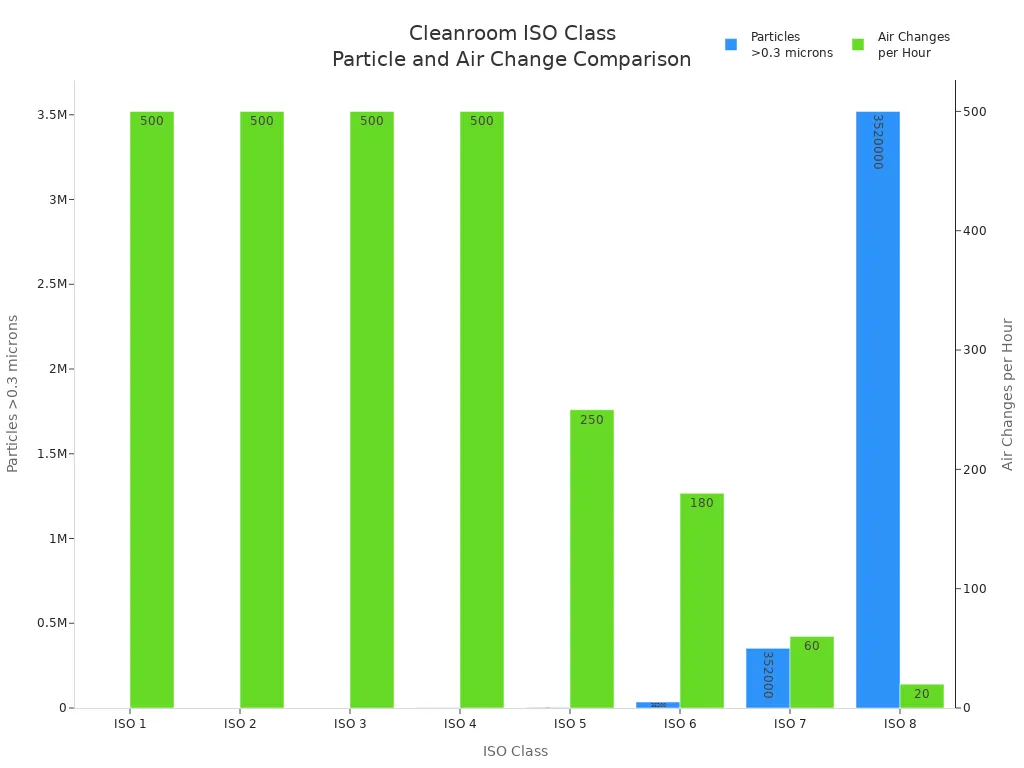
You need to select cleanroom lighting that fits your ISO class. For example, ISO 1 and ISO 2 require ultra-low particle emission and the highest filtration. Lower classes, like ISO 7 or ISO 8, allow more particles and use less strict lighting solutions.
Lighting Performance Criteria
Cleanroom lighting must provide the right brightness and color quality for your tasks. You need enough light to see details and spot contamination. The color temperature and color rendering index (CRI) play a big role in how well you can inspect surfaces and detect problems.
Here is a quick guide to recommended lighting performance:
Aspect | Recommendation |
|---|---|
Color Rendering Index (CRI) | 80+ |
Color Temperature | 4000K – 5000K |
Color Rendering Index (CRI): A CRI of 80 or higher helps you see colors accurately. This makes it easier for you to spot defects or contamination.
Color Temperature: A range between 4000K and 5000K gives you bright, neutral white light. This reduces eye strain and improves your ability to inspect products.
You should also look for uniform light distribution. Shadows and glare can hide contamination and make inspection harder. LED fixtures often provide the best performance because they offer high CRI, stable color temperature, and energy efficiency.
Note: Cleanroom lighting with high CRI and proper color temperature helps you maintain quality control and safety.
Summary Checklist
Choose lighting that meets ISO and GMP standards.
Match fixtures to your cleanroom classification.
Select lights with CRI 80+ and color temperature 4000K-5000K.
Use sealed, non-shedding fixtures to minimize contamination.
Ensure uniform light distribution for accurate inspection.
Cleanroom Lighting Fixtures

Fixture Types
You can choose from several types of fixtures for cleanroom lighting. Each type offers unique benefits for your workspace. The most common options are LED cleanroom lights and fluorescent lights. The table below shows how these fixtures compare:
Lighting Fixture Type | Advantages |
|---|---|
LED Cleanroom Lights | Lower energy use (about 50% less) |
Fluorescent Lights | Higher energy use |
LED fixtures give you more control over brightness and help you save money on energy bills. Fluorescent lights need more maintenance and can cost more over time.
Material and Construction
You need fixtures made from materials that do not shed particles. Stainless steel and powder-coated aluminum are popular choices because they resist corrosion and stand up to harsh cleaning agents. Sealed construction keeps dust and moisture out. You should look for smooth surfaces and rounded edges, which make cleaning easier and prevent bacteria from hiding in corners.
Tip: Select fixtures with chemical-resistant seals. These seals help you maintain a sterile environment and extend the life of your lighting system.
LED Lighting in Cleanrooms
LED lighting has become the top choice for cleanrooms. You benefit from lower power usage and less heat, which helps you control the temperature in your workspace. For example, a 300x600mm LED panel uses only 20 watts, and a 300x1200mm panel uses 40 watts. This means you can cut energy use by 50-75% compared to older fixtures.
LEDs do not contain mercury, so you avoid pollution risks and hazardous waste. Fluorescent lamps have mercury, which can contaminate your cleanroom if a bulb breaks. Improper disposal of fluorescent bulbs can also harm the environment.
LEDs are mercury-free, so you reduce contamination risks.
Fluorescent tubes can create hazardous waste if not disposed of properly.
You get reliable, efficient, and safe lighting when you choose LEDs for your cleanroom.
Selecting Cleanroom Lighting
Key Selection Factors
When you choose cleanroom lighting, you need to focus on several important factors. These factors help you create a safe, efficient, and compliant workspace. Here is a list of what you should consider:
Make sure your lighting meets ISO 14644-1 and GMP standards. These standards protect your cleanroom from contamination and help you pass inspections.
Check that the illuminance levels match the needs of each zone. Different areas require different brightness for tasks like inspection or assembly.
Control glare and improve visual comfort. Low Unified Glare Rating (UGR) values help you work without eye strain.
Select fixtures that resist contamination and are easy to clean. Smooth surfaces and sealed designs keep your environment sterile.
Look for energy efficiency and low lifecycle costs. Efficient lighting saves you money and reduces maintenance.
Tip: Always review the specifications of your lighting fixtures before installation. This step helps you avoid problems and ensures long-term reliability.
Energy Efficiency
Energy efficiency plays a big role in cleanroom lighting. You save money and reduce your environmental impact when you choose efficient fixtures. LED cleanroom lighting lasts up to ten times longer than traditional fluorescent options. You also cut energy costs by more than 55% when you switch to LEDs.
LEDs help you lower your electricity bills.
You spend less time and money on maintenance because LEDs need fewer replacements.
You can check for certifications that show high energy efficiency. The table below lists two common certifications and what they mean:
Certification | Description |
|---|---|
Indicates that a lighting product meets strict energy efficiency standards set by the U.S. EPA, ensuring high performance and environmental benefits. | |
Title 20 | Signifies compliance with California’s energy efficiency standards, ensuring the product can be legally sold in the state and helps reduce energy use. |
Note: Certified fixtures help you meet energy codes and qualify for rebates or incentives.
Safety and Compliance
Safety and compliance matter in every cleanroom. You need lighting that supports your safety goals and meets all regulations. Fixtures must use sealed construction and non-shedding materials. These features prevent particles from entering your workspace and protect your products.
You should also check that your lighting system supports emergency protocols. Backup power and proper placement help you maintain visibility during outages. Regular inspections and documentation keep your cleanroom lighting in line with industry standards.
Choose fixtures with chemical-resistant seals.
Schedule routine checks to maintain compliance and safety.
Cleanroom lighting affects your daily operations and long-term success. When you select the right fixtures, you create a safer and more efficient environment.
Installation and Maintenance
Installation Guidelines
You need to install cleanroom lighting with care to protect your sterile environment. Always choose fixtures made from chemical-resistant materials like stainless steel or powder-coated aluminum. These materials resist corrosion and make cleaning easier. Make sure each fixture has a sealed design to keep out dust and moisture. Place lights so they provide even coverage and reduce shadows. Use smooth, rounded surfaces to prevent particle build-up. When you install, wear cleanroom-approved gloves and clothing to avoid introducing contaminants.
Tip: Double-check all seals and gaskets after installation. Proper sealing helps you maintain cleanroom integrity.
Cleaning and Maintenance
Regular cleaning keeps your lighting fixtures working well and your cleanroom safe. Follow these steps to maintain sterility:
Remove any visible debris or tools from the area.
Use a cleanroom-compatible vacuum to dust surfaces, starting with ceiling fixtures.
Wipe down all surfaces, including lights, with a clean microfiber cloth or disposable wipe and a cleanroom-approved disinfectant.
Inspect your work and document the cleaning for compliance.
Choose cleaning agents that are cGMP-approved, non-foaming, and neutral or non-ionic. Deionized or distilled water works well with these agents. Use woven polyester or sterile wipers for lint-free cleaning. Wet cleaning is best when dry wiping does not remove all residue.
Keeping up with regular maintenance reduces contamination risks and helps your fixtures last longer.
Troubleshooting Issues
You may face lighting problems in your cleanroom. The table below shows common issues and solutions:
Issue | Solution |
|---|---|
Electrical Component Failures | Keep spare parts on hand and schedule regular preventive maintenance checks. |
Light Levels | Adjust illumination to match each process area and minimize glare. |
Housings and Lenses | Use durable, easy-to-clean materials like stainless steel and acrylic for long-term reliability. |
Regular maintenance ensures your lighting performs at its best. This practice supports cleanroom reliability and helps you avoid unexpected downtime.
You need to focus on several essentials when you plan cleanroom lighting. Follow these steps to ensure optimal performance and compliance:
Choose fixtures that meet ISO and GMP standards.
Select durable materials to reduce maintenance.
Use energy-efficient solutions like LEDs.
Provide uniform lighting for every task.
Effective cleanroom lighting helps you maintain sterile conditions in industries such as pharmaceuticals and biotechnology. Proper lighting supports compliance, boosts productivity, and improves operational efficiency. Advanced technologies, including far-UVC light, offer new ways to control contamination:
Advantage | Description |
|---|---|
Efficient Decontamination | Far-UVC light inactivates microorganisms on surfaces and in the air. |
Continuous Air and Surface Sanitation | Ongoing decontamination in high-traffic areas while operators are present. |
Seamless Integration | Integrates with existing cleanroom technologies for better contamination control. |
You can improve your cleanroom by evaluating your current lighting and upgrading to modern systems. Proper lighting protects your products and supports your success.
FAQ
What makes cleanroom lighting different from regular lighting?
Cleanroom lighting uses sealed, non-shedding fixtures. You get materials that resist chemicals and allow easy cleaning. These lights help you control contamination and meet strict industry standards.
How often should you clean cleanroom lighting fixtures?
You should clean fixtures during regular cleanroom maintenance. Most facilities clean lights weekly or monthly. Always follow your cleanroom’s cleaning schedule and use approved cleaning agents.
Can you use LED lights in all cleanroom classes?
Yes, you can use LED lights in any cleanroom class. LEDs offer high efficiency, low heat, and sealed designs. You get reliable performance and easier compliance with ISO and GMP standards.
What should you do if a light fixture fails in a cleanroom?
Replace the fixture as soon as possible. Wear cleanroom-approved clothing and gloves. Check seals and document the repair for compliance. Always use certified replacement parts.
Do cleanroom lights help reduce energy costs?
Lighting Type | Energy Use | Maintenance |
|---|---|---|
LED | Low | Minimal |
Fluorescent | High | Frequent |
You save energy and lower costs with LED cleanroom lights. LEDs last longer and need less maintenance.